Showing posts with label Understanding Generation i. Show all posts

Monday, October 26, 2015

The Gift of Failure: First Impressions

Good morning,

I've just completed the Introduction and Chapter 1 of The Gift of Failure by Jessica Lahey and my first impressions of what is to come are favorable. First and foremost, the author is not a lecturing, "How-could-you?" voice of condemnation. To the contrary, she employs a reassuring, "I'm-with-you" voice as she offers her own parenting approach up for us to understand the journey to raising self-sufficient children.

Ms. Lahey does a particularly masterful job of outlining the history of parenting in America from colonization through the present day in a manageable and entertaining 14 page first chapter. As a father of three, four and under (and a daughter who is 4 going on 16...), I was particularly drawn to her John Locke quotations. Here is one of those gems:

"Locke advises, 'crying is very often a striving for mastery and an open declaration of their insolence or obstinacy: when they have not the power to obtain their desire, they will by their clamor and sobbing maintain their title and right to it' (emphasis Locke's, and I can almost hear the derision dripping from those horrid, emotional words)."

Lahey goes on to outline the progression from parenting as a matter of survival to the helicopter/interventionist approach of today: "Today, parenting is less oxytocin-soaked rosy glow, more adrenaline-fueled oncoming headlight glare."

I recommend it heartily and if the above quotation offers anything, it should be an indication of the sensibility and humor with which Ms. Lahey approaches her subject matter.

Please enjoy!

Monday, August 18, 2014

The Future is Here: Apple, IBM Form Business Apps Partnership

http://miapplesinteractive.blogspot.com
If you didn't think our kids need to know how to navigate in a mobile tech world, this announcement from Apple and IBM, should wake you up. The two tech rivals are going into business together to take advantage of each other's strengths and complete the transformation of the way work gets done. As they said in their joint statement:

The business enterprise partnership, announced after Tuesday's market's close, aims to "redefine the way work will get done, address key industry mobility challenges and spark true mobile-led business change,'' the companies said in a joint statement.
This is no joke. Our kids need to learn how to use these tools to make their lives more efficient and be ready to make their future businesses more efficient.

Apple, IBM  Form Business Apps Partnership 

Thursday, August 14, 2014

Teen Girls and Harsh Realities of Online Popularity

http://weheartit.com/entry/group/2994788
This article from TIME focuses on a survey by the social network We Heart It, delves into the ways teen girls gauge popularity and how to work way into online popularity. Some of the more intriguing rules that the survey uncovered include: 

  1. Don’t serial post. (“You only want to post one Instagram a day.”)
  2. If you do post multiple things per day, they’d better be amazing. (“You can post multiple tweets a day, but they can’t be stupid or not interesting.”)
  3. If you game the system, don’t get caught. (“She [my friend] probably has 20 fake accounts where she goes and likes her own pictures.”)
Check out the article at the link below: 

Monday, May 5, 2014

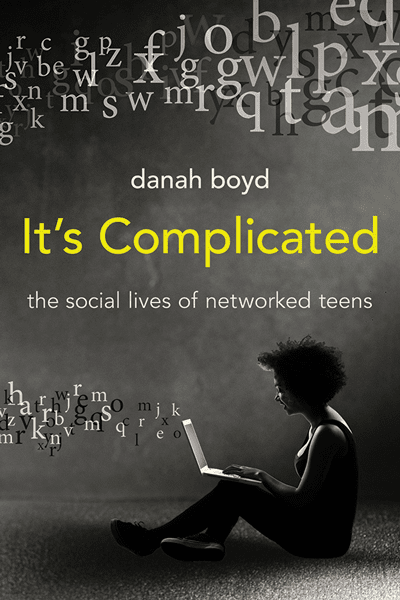
It's Complicated: A Book Review

This book review was originally posted on the SAIS website on 5/1/2014.

Teens & Social Media: It’s Complicated
A review of danah boyd’s new book, It’s Complicated: The Social Lives of Networked Teens
By David Skeen

Once upon a time in a land far, far away young people lived idyllic lives. Teenagers, as they were called, always - always - obeyed their parents. They would sit enthralled at the knees of their mothers and fathers, soaking up the hard-earned wisdom of these adults. Teens would tell their parents everything that was happening in their lives from the moment they woke up to the time they went to bed - at a reasonable hour, of course. Teens knew they needed their sleep and got plenty of it.  Teen years were happy, simple and easy.

One day an evil sorcerer named Internet arrived in the kingdom. Internet and his minions, MySpace, Facebook, Snapchat, Instagram, YouTube, and Twitter (collectively known as “Social Media”) enticed and lured teenagers to share their lives and ideas. As Internet’s insidious relationship with the youth of the kingdom took hold, teenagers grew moody, often shunning time with their parents so they could “hang out” with their friends. Parents knew very little about what was happening in their lives and were worried their children were not getting enough sleep. Most concerning of all, teens were pushing boundaries with their parents and searching for - gasp - their own identities.

In her new book, It’s Complicated: The Social Lives of Networked Teens, danah boyd (she does not capitalize her name) debunks the above fairy tale and brings us back to reality regarding “the anxieties that many American adults have about teens’ engagement with social media” (p. 5). Through ten years of study, 166 interviews with teens around the country, work at Berkeley, Harvard, and NYU (the twenty-one page bibliography is a testament to the depth of research), as well as her day job as Principal Researcher at Microsoft Research, danah boyd has written a book that is an essential read for educators and parents.

boyd’s premise begins with the idea that teen issues today are the same as they have always been.  Despite what she finds as a common desire by teens to hang out in person a combination of society’s fear and anxiety around our children, reduction in access to interpersonal settings such as the mall or the park and overscheduling force teens to flock to social media to do what teens do: socialize. These new “networked publics,” as boyd calls them, provide teenagers with what they’ve always wanted - opportunities to connect “with other people and have the freedom of mobility.” (p. 10)

The internet is neither good nor bad and social media is neither good nor bad. Both, however, are here to stay. Social media will not, as boyd outlines, usher in a utopia or destroy society but instead will act as a “reflection of our society and that mirror is going to be reflecting what we see. If we do not like what we see in that mirror the problem is not to fix the mirror, we have to fix society” (p. 212).  With this tenet in mind, boyd delves into seven topics related to teens and their networked world: identity, privacy, addiction, danger, bullying, inequality and literacy. Throughout each chapter, boyd maintains a narrative that is grounded in sociology rather than technology. Her findings are revealing. Some of the most intriguing include,

  • Teens today are “public by default and private through effort.” (p. 61)
  • Teens aren’t necessarily addicted to social media, but rather, as has long been the case, addicted to each other. (p. 80)
  • With the introduction of social media, like Elvis, comic books, and TV before it, parental anxieties are regenerated and the medium of the cultural shift becomes the target of a “moral panic.” (p. 105)
  • Teen friending patterns on social media consistently reinforced existing social divisions. (p. 165)
  • Digital Native vs. Digital Immigrant is a false precept. It abdicates our responsibility to teach our kids digital and media literacy. (p.180)

boyd’s voice of reason and research driven narrative provides a straightforward framework for conversations with teenagers. It’s Complicated should be required reading for all educators and parents in order to better understand this new(ish) platform of social media and its impact on our world. The good news is, as boyd herself states, while the names of Internet’s minions may change, the underlying story remains the same. Lessons learned from this book are enduring.

For most independent school educators, this work probably confirms a lot of what we have intuited about teen life and, therefore, offers a bridge for conversation with anxious parents. For parents, the book provides a calming voice. One who has an intimate knowledge of teenagers is saying quite clearly, “Our children’s world may be more complicated than we ever imagined but, by and large, they are going to be OK.”

Tuesday, April 22, 2014

#Socialnomics 2014 by Erik Qualman


By now you've all seen the video that discusses how quickly the world has changed. Here is an updated version for your enjoyment.

Thursday, March 20, 2014

A Visual for the Growth Mindset

This is a great infographic on the Growth Mindset.


Saturday, March 8, 2014

Must Read: It's Complicated by Danah Boyd

I've heard great things about this book and it comes from someone who spent a lot of time speaking withthose most affected - teens!

Check out an excerpt from an interview on Science Friday, as well as the Mind/Shift blog at this link:

Texts, Snapchats, Instagram: Translating Teens' Online Behavior

Wednesday, January 8, 2014

How Are Students Using Their Smartphones

I found another infographic I thought you might like on how students are using their smartphones. Some warnings on this particular study:

  1. It was administered by STUDYBLUE, a mobile and online study service, so there is some self-interest involved. 
  2. Despite #1, they did collect data from over a million users of their app and website. 
  3. There is still a lot of "other" things students are doing with their Smartphones during the study time, but an interesting conclusion that studying is happening more, overall with mobile technology. 

Monday, November 18, 2013

Minecraft Utopia Projects

In our 6th Grade Humanities classes, Karen Niegelsky had students develop their own utopias. A few groups used Minecraft to create theirs. What transpired was pretty incredible. Check it out:

Wednesday, November 13, 2013

BYOD: Achieving Learning Outcomes Across Operating Systems

Below is an infographic that shows how you can achieve learning outcomes regardless of the operating system. This is just a taste of the possibilities. From edudemic.com


Monday, November 11, 2013

NCAIS Innovate: BYOD @ C'Bury

On Friday, November 1, John Schoultz and I presented at the NCAIS Innovate Conference. Many thanks to Laura Blackburn and the NCAIS team for setting up a great conference. Below is our presentation:


Tuesday, November 5, 2013

The Help Desk....

When I was at the NCAIS Innovate Conference at Noble Academy last Friday, Michele Gutierez shared these hilarious videos to set a context for her talk on digital literacy. I wanted to pass them along:


Tuesday, October 22, 2013

Social Media: Do We Know What is Cool?

I found this infographic at leaderswest, Digital Marketing Journal, and thought it was a great outline of what our kids are really using for social media:


Friday, October 4, 2013

Generations of Internet Users

I found this cool infographic at edudemic.com and wanted to pass it along. It's a pretty detailed look at how different generations use the Internet.


Monday, September 30, 2013

Monday, September 16, 2013

Resilience: How Skateboarding Can Teach Us How to Learn

I found this video on Twitter and thought it was a great way to think about how important resilience is to learning. Struggle and failure are GOOD things!


Friday, September 13, 2013

Technology and Kids: A GOOD Story

Scott McLeod presented at TEDxDesMoines and gave a great talk about the positive aspects of kids and technology, particularly extracurricular empowerment. Great stuff.


Wednesday, September 11, 2013

Emerging Technologies in Education

This article may be underestimating how fast some of these technologies will be incorporated into schools. Fascinating to think about the rapidity of change that we are facing and how we prepare our students for it.

10 Specific Examples of Emerging Educational Technologies