Monday, December 15, 2014

A Christmas Sermon

The following is a guest post from one of our 8th graders, Clare. She gave her sermon this morning in Phillips Chapel in front of 400 or so of her closest friends and relatives. Each year, almost all of our 8th graders give a sermon offering their thoughts on life, spirituality, family, or school. A hallmark of the school, the 8th grade sermons have flourished under the leadership of Fr. Finnin, our school chaplain who has provided a more refined spiritual focus. 

Clare's sermon discussed how a Christmas Tree is a representation of life and that each and every one is an ornament that deserves a spot on that tree. Check it out: 

Good Morning.

For those who know me, know that I love Christmas. This is my favorite time of the year for so many different reasons. When I started thinking about my sermon, I knew that this would be the perfect time of the year. As I was remembering previous Christmas’, a certain story came to my mind.

A few years ago my family and I were decorating our Christmas tree. Everyone in my family had a particular job when decorating the tree. I was in charge of the red ornaments. As I was unloading the ornaments and placing them on the tree, I noticed one without a top and hook. Because there wasn’t a top and hook, I put it back into the box. After I was done with the rest of the ornaments, I looked back at what was left. The same red ornament was sitting alone at the bottom of it’s box. I realized that all I needed to do was to find a top and a hook, and that red ball could be on the tree like all the others. So I found a top, and I found a hook, and eventually that red ball fit perfectly on the Christmas tree.

You might be wondering how this has to do with you...me...Chapel…and just life. Well it has a lot. Imagine life as a big Christmas tree. A Christmas tree is big, green, fragrant, but there is something missing… the ornaments. And we are the ornaments of our Christmas tree. We come in different shapes, sizes, and color. And when we are on our Christmas tree, it is amazing!

As Perrin just read, "If the whole body were an eye, where would the hearing be? If the whole body were hearing, where would the sense of smell be?" Imagine a Chtmas tree with just green ornaments, or all circle shaped ornaments. That would be sort of boring wouldn't it? This also goes along with real life situations. It would be boring if there were only 8th graders on the planet, or only people who can sing, or only people who are really good at math. We all have our special talents and we need each other's help and gods help finding them.

Unfortunately, there are many people who don't think they belong on the tree. For whatever reason, they feel like they have lost their top or lost their hook, and don't belong with others on the Christmas tree of life. They don’t realize that they aren't alone. These people don’t know that God made the Christmas tree big enough for everyone. People shouldn’t make fun of someone’s scratch when they might be hiding a dent. Like what Matthew 7:1-5 states, "Why do you look at the speck of sawdust in your brother’s eye and pay no attention to the plank in your own eye?" This is talking about someone judging another person for a flaw, when that very same person has an even bigger flaw. This relates to my story because some people are not helping people find their hooks or their tops. Many people make fun of other people who have a difficulty or a clear difference, even though those same people have difficulties and struggles themselves.

Take a minute and think about a time that you felt like you didn't belong or someone made you feel like you were missing something or that you weren't like the other people. ......you have probably felt this sometime in your life if you have ever been to a new school and didn't know anyone, or you have been bullied for something you couldn't help. I have personal experience thinking that I didn’t have a hook or top and that I didn't exactly belong. I have had people insult me for being different or just because of having difficulties with different things. I used to think they were right and they might have been, but I didn't realize that they had differences too. I have always complained to my parents about myself having issues, but not other families or some of my friends. They always told me that you may not see their difficulties, but they have them.

I challenge you over this Christmas break, to see your differences in a good way and not to only see your differences, but to see your talents. And to make sure all your ornaments make it onto your Christmas tree. And remember, everyone has a top, a hook, and most of all, a place on God’s tree. Amen.
Friday, December 5, 2014

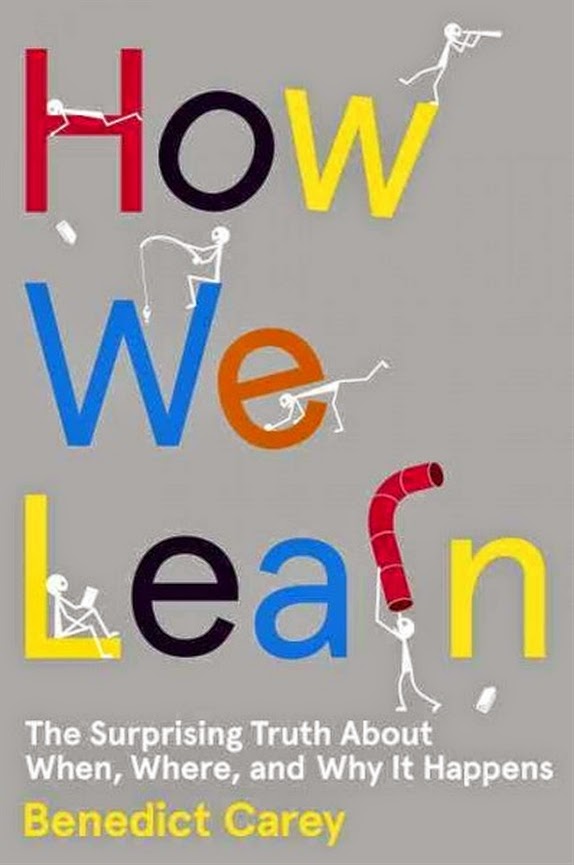
How We Learn: The Surprising Truth About When, Where, and Why It Happens

This book review originally appeared as part of the December 4 SAIS eNewsletter

If you were to put the major influences on how our brains developed in terms of shaping the way we learn onto a timeline, the first million-or-so years would consist of two main contributors: the search for food and the unending desire to survive. It is only in the last few thousand years that more ephemeral influences have begun to impact the way our brains adapt for learning. It is only in the last few hundred years that we as a species have put an edifice of education of our own creation around what we perceive to be the way we learn. 

The problem with this, says Benedict Carey, a New York Times science reporter and author of the book, How We Learn: The Surprising Truth About When, Where, and Why It Happens, is that this artifice of education often ignores all of the ways the brain really learns. What we’ve been taught about studying, practicing, and solving limits our ability to make learning last. Carey offers concrete strategies to capitalize on the first million years of brain development - that which made us hyper-aware of our surroundings, intent on finishing a project because of the need to accomplish a goal, or perceiving multiple factors at once to inform our next move. He accomplishes this by offering up a plethora of meta-research, experiments, personal anecdotes, and even puzzles to bring his points home. In fact, this is one of the more appealing aspects of the book - if you are looking for a relatively concise compilation of major research on the brain, memory, forgetting, and learning, How We Learn is an excellent resource. 


How We Learn, through Carey’s organization of the research, provides for the layperson an accessible and comprehensive account of the science behind learning. He divides his narrative into four main parts. In part one, he brings everyone up to speed on the biology of learning and the role that forgetting plays in how we learn. A little forgetting is good because it means you work the memory muscle when you need to recall something. Part two focuses on the retention of knowledge and builds on the memory theme by delving into the relationship of learning in different contexts to aid in retrieval of information, spaced learning or knowing when to start studying, and self examination as an active means of study. Part three discusses the best way to solve more complex problems and it is in this section of the book, where Carey’s best work lies. He does a masterful job of articulating the steps involved in the “Insight Experience” (p. 114), the power of percolation around a problem, and “interleaving” or mixed-up practice (p. 171). Finally, part four introduces the intriguing realm of perceptual learning modules as a means to “supplement experience” (p. 186) and dutifully outlines the importance of sleep in consolidating learning across modes, physical and/or mental. 


While Carey does an excellent job compiling interesting studies and organizing research on learning into categories that make sense, the outcomes of that research and how he proposes we use them practically are not really new news. For example, Carey’s insight about spacing study sessions over multiple days to make your mind work harder to recall information is, essentially, our teachers’ admonition to study a little at a time. His advice about taking a break and distracting yourself when stumped on a problem in order to capture that a-ha! moment when you return to work is essentially like taking a coffee break in the faculty room. His point about using multiple choice testing to force the brain to eliminate bad choices and “tune it” towards the right one is essentially every high school junior’s primary strategy going into the SAT. This is not to say these are not important points to keep in mind and understand as teachers, because they are. But for the most part, educators who are focused on best practices, research, and influential trends on education will not find any groundbreaking ideas in this book. However, it could be a great resource for new teachers, inquisitive and committed parents, and students who, in Carey’s words, may need to “broaden the margins” (p. xi) and give themselves a break every once in a while. 


Saturday, November 8, 2014

What is that Canterbury Something?

In my role as Middle School Director, I am able to speak to various people who interact with Canterbury graduates. A common response near the beginning of our conversation is, “Oh! We know Canterbury kids when we see them. We can’t put our finger on it, but there is just something about them.”

Over the last four years, I’ve been trying to pinpoint what that “something” really is. I’ve come up with three distinguishing characteristics of Canterbury kids.

However, I think it is important to acknowledge that we start with incredible kids, who come from great and committed families, and whose backgrounds and experiences are vast in their diversity. This, I think, is a direct result of being an Episcopal school whose core purpose is to create a community where students are exposed to an array of people, perspectives, and ideas.

Now, to the characteristics. Because we are a small school, one in which our kids are known, cared for, and loved, we are able to develop a program that helps children become young men and women who

Advocate
Reflect, and
Lead

Starting from PK through 8th grade our students are learning to advocate for themselves and others. Whether it be including friends in a game on the playground, learning to use their words to express themselves in 1st grade, posing an hypothesis in science, or arguing about format in group work, learning to advocate for one’s self in their learning translates into positive action after Canterbury. Our kids aren’t afraid to tell you what they think and why they think what they do. That’s powerful.

Our students learn the power of reflection early on in Kindergarten carpet discussions and it continues from there to assignments like the ABC project in 4th grade and finally culminating in year long projects like the 8th Grade Portfolio and sermons. The sermons in particular are a fantastic manifestation of this characteristic of reflection in our students. Last year, 100% of our 8th grade class gave a sermon, which is an opportunity to discuss one’s spiritual journey in front of 400 of their closest friends! This skill of reflection - of what went well, what didn’t go well, what will I change the next time - not only helps to solidify a lifelong approach to learning, but further enhances in our students a sense of resiliency. Our kids will use their missteps, mistakes, and even failures to make themselves and those around them better.

This last point leads to the last skill our students develop - leadership. Canterbury students lead. Because of our K-8 structure, students who in some other situation at a K12 school wouldn’t be called upon to lead, now have a lot of opportunities to do just that. What further distinguishes our students, I think, is that through programs like our servant leadership classes, spiritual development and theology classes, and our sports teams, our students lead not for the glory, but because of a sense of duty. Add to this sense of duty a skillset comprised of advocacy and reflection and the orientation of Canterbury leaders is one of “How can I help?” What this means is that our students are “natural” leaders. Canterbury leaders seek out the needs of their community, reflect on how they can help, and work with others to serve those needs.

So, when 8th graders leave Canterbury and enter into their high school world and the greater Greensboro and Guilford County world that “something” people mention is their skill set at work. If everybody describes our kids this way, it means we’ve helped to develop the whole child who become incredible young men and women ready to make their world a better place. That’s powerful and shouldn’t that be every school’s endgame?

Thursday, September 18, 2014

Parent/Teacher Conference Sign Up: September 30, 2014

Dear Parents,


I am writing to introduce the framework for our Parent/Teacher Conferences on Sept. 30. The goal of these conferences is to have an opportunity to meet with your child’s subject teachers to discuss specific class issues; create, update, or modify existing support structures; or address comments from the Haiku gradebooks.


The format of these conferences is different from the lower school. First, we do not require you to meet with all of your child’s teachers. We encourage you to identify those classes where a conference will be most productive and make those a priority when signing up for a time slot. If you have received an email or phone call from one of your child’s teachers requesting a conference Sept. 30, please make every effort to do so.


Second, we do not set your conference schedule. There is a link to the conference sign-up sheet below, and we ask that you fill in a time slot with the appropriate teacher on your own. Teachers have their own tabs at the bottom of the screen. Once you are on their page, you will see the subject they teach and slots that can be filled in with your name. Please don’t save multiple slots on a teacher’s sheet while working out schedules, as this limits others ability to make an appointment.


Third, conferences are scheduled for 10-minute increments with five minutes between conferences so the teacher can prepare. I realize you may still need more time. You can always make an appointment with a teacher for another day. To be fair to all the other families, please keep conferences to the 10-minute time limit.


Canterbury School will offer drop-in child care for Canterbury students on conference days again this year. Our first conference day is Tuesday, September 30. There is no charge, and care lasts the duration of your family's scheduled conference. Children must be enrolled at Canterbury School to attend (sorry, no younger siblings).


Thank you for your continued support and partnership as we work to develop outstanding middle school students. If you have any questions, please do not hesitate to contact me at skeend@canterburygso.org or 336-288-2007 x131.


Sincerely,


Dave


David Skeen
Middle School Director

Wednesday, September 3, 2014

Back to the Future: Experience 21st Century Teaching and Learning on Back to School Night

"Marty! Do you realize what this means?"


This classic line from Doc Brown in “Back to the Future” is perhaps overused, but in this case it is both appropriate and a little scary considering this fact: In “Back to the Future 2,” Marty travels into the future to the year 2015. Let that marinate a little bit...


We're not using hover-boards as regularly, nor do we fly our cars in express lanes, so our new Back to School Night (BTSN) format won't include an explanation on how the flux capacitor works, but it will provide a glimpse into how your children are learning in the 21st century. What follows is a description of the reasons behind this format change, what you can expect in terms of your experiences, and the schedule for the night.


School is Different Today

School is different today and for all the right reasons:
  1. Brain-based research has provided a deeper understanding of how people learn, thus providing insights into effective teaching practices.
  2. Developmental understandings of adolescents has deepened as well, meaning learning shouldn't just be about the WHAT anymore. The world in which our children will find themselves will be one defined by change, and the skill sets needed for this world are not content based necessarily, but relationship based.
  3. Part of that change is the role of technology and how to leverage its power. We see this most powerfully as a means to connect, while balancing its use in order to develop those relationship skills that will be so essential.


Why Change the Format of Back to School Night?

It is important to have some context around the decision to move to a new BTSN format. Over the course of the last few years, I've noticed trends that, taken together, instigated this change.
  1. The information being shared at BTSN was of a very basic nature and was being shared electronically with the students and parents anyway, thus creating a redundancy in communication.
  2. As middle school students move up in grades, there has a been a correlating drop in parent attendance at BTSN.
  3. There has been a lot of change in the middle school over the last four years, and while I have strived to fully communicate it in my Parent Preview letters and other communication outlets, such as this blog, the benefit to your children is best communicated through your own experience.


But I Love the Nuts and Bolts...

We believe it is important to show you how different school really is, and a perfect time to do so is BTSN. However, we understand that many of you rely on BTSN for the nuts and bolts of a class: How can I reach the teacher? What will my child be learning? How will they be assessed on that learning? How much homework can we expect at home? In response, each teacher has created a video which outlines that information for you. The videos will be embedded in their Haiku page, which you will learn more about from John Schoultz. Below is an example of the type of video you might see on a class page.


So What's So Different, Then?

Three things are different about this BTSN. First, starting in Berry Hall, we will launch our new Haiku platform, the main mode of communication moving forward. John Schoultz, our Instructional Technology Coordinator, will outline the basics of logging in and navigating through Haiku. After his presentation, you will receive an email with your log-in credentials and links to video tutorials, so you can access the platform right away.


Second, you will hear from Kathryn Wolfson, our new Guidance Counselor, about the Top 5 Guiding Principles in teaching adolescents. She will explain why these principles are so important to how we shape the middle school experience at Canterbury, and give you a sense of why we teach your children the way we do.


Third, you will move to Armfield Hall and attend two mini-lessons in your child's grade. Your assigned classes are at this LINK. Each lesson will last about 25 minutes and you'll have the opportunity to both engage in the material and ask questions about the process. Obviously, technology is a critical piece of the experience, and you will certainly see how it is integrated into a lesson, but we won't ask you to bring an iPad or laptop. Instead, we will show how your child would incorporate technology into the lesson.


Now What?

We want BTSN to be a launching pad for our partnership in your child's learning. We hope that through this new experience, you will have a better understanding of the expectations we have for the students and feel better prepared to support your child as he or she grows in middle school. At Parent-Teacher Conferences on Sept. 30, you can meet with your child's teachers one-on-one to further deepen that partnership. Our goal is to keep you fully informed about what is going in your child's experience at Canterbury, what best practice in middle level education is, why we believe it is important to do the things we do, and how we go about implementing those priorities at Canterbury.


We are excited to welcome you Back to the Future to experience 21st century teaching and learning for yourself.


The Night's Schedule

Here is the night's schedule.  

  • 6:00 - 6:30: Ketner Science and Technology Building Tours (optional) led by Burns Jones, Head of School
  • 6:30 - 7:00: Berry Hall
    • Welcome from Burns Jones, Head of School
    • New Middle School Teacher Introductions, Burns Jones, Head of School
    • Annual Fund Introduction, Matt and Rhonda Wakefield, Parents '18 & '20
    • Haiku Introduction, John Schoultz, Instructional Technology Coordinator
    • Guiding Principles of Teaching Adolescents, Kathryn Wolfson, Counselor
  • 7:05 - 7:30: Mini-lesson Session 1
  • 7:35 - 8:00: Mini-lesson Session 2

Tuesday, August 19, 2014

The Future of Talent is Potential: HBR Podcast

http://www.gradweb.co.uk/
In this fascinating podcast from HBR.org, Linda Hill and Claudio Fernandez-Araoz, discuss how businesses are shifting away from core competencies their workers need, and towards identifying potential for workers to adapt to ever-shifting problems and tools. Specifically, Fernandez-Araoz identifies five characteristics that great employees will have:

  1. A fierce, passionate commitment to unselfish goals
  2. Curiosity
  3. Insight - holistic thinkers
  4. Engagement - a willingness to engage others in the pursuit of a common goal
  5. Determination and resilience
The premise of Canterbury is to develop all of these characteristics in our students across a myriad of experiences, so they can be the future talent in high school, college, and the workplace. 

You can see it in our servant leadership and leadership program. 

You can see it in our STEM program with its foundational problem based approach. 

You can see it in our social studies program through events like the Millenial Development Goals project, where curiosity is stoked. 

You can see it in our Episcopal identity. 

You can see it in our students.