Showing posts with label The Brain. Show all posts

Friday, December 5, 2014

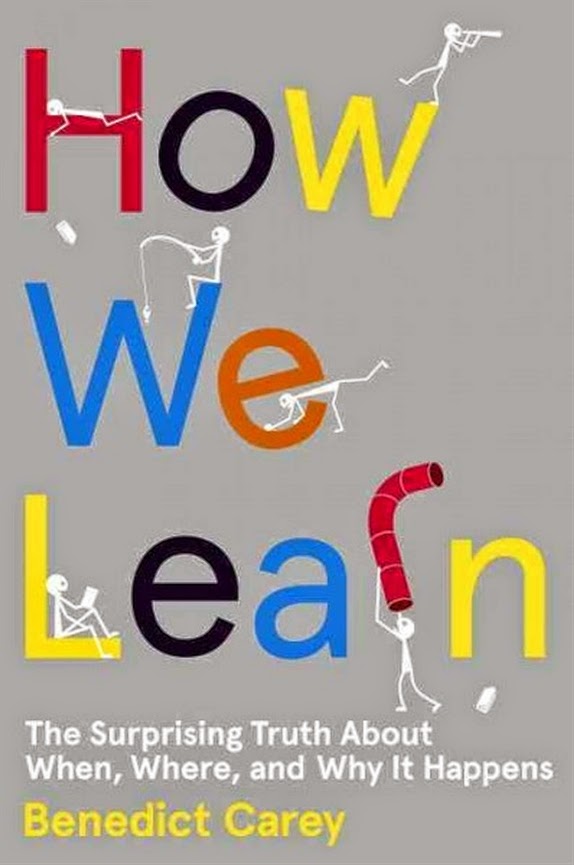
How We Learn: The Surprising Truth About When, Where, and Why It Happens

This book review originally appeared as part of the December 4 SAIS eNewsletter

If you were to put the major influences on how our brains developed in terms of shaping the way we learn onto a timeline, the first million-or-so years would consist of two main contributors: the search for food and the unending desire to survive. It is only in the last few thousand years that more ephemeral influences have begun to impact the way our brains adapt for learning. It is only in the last few hundred years that we as a species have put an edifice of education of our own creation around what we perceive to be the way we learn. 

The problem with this, says Benedict Carey, a New York Times science reporter and author of the book, How We Learn: The Surprising Truth About When, Where, and Why It Happens, is that this artifice of education often ignores all of the ways the brain really learns. What we’ve been taught about studying, practicing, and solving limits our ability to make learning last. Carey offers concrete strategies to capitalize on the first million years of brain development - that which made us hyper-aware of our surroundings, intent on finishing a project because of the need to accomplish a goal, or perceiving multiple factors at once to inform our next move. He accomplishes this by offering up a plethora of meta-research, experiments, personal anecdotes, and even puzzles to bring his points home. In fact, this is one of the more appealing aspects of the book - if you are looking for a relatively concise compilation of major research on the brain, memory, forgetting, and learning, How We Learn is an excellent resource. 


How We Learn, through Carey’s organization of the research, provides for the layperson an accessible and comprehensive account of the science behind learning. He divides his narrative into four main parts. In part one, he brings everyone up to speed on the biology of learning and the role that forgetting plays in how we learn. A little forgetting is good because it means you work the memory muscle when you need to recall something. Part two focuses on the retention of knowledge and builds on the memory theme by delving into the relationship of learning in different contexts to aid in retrieval of information, spaced learning or knowing when to start studying, and self examination as an active means of study. Part three discusses the best way to solve more complex problems and it is in this section of the book, where Carey’s best work lies. He does a masterful job of articulating the steps involved in the “Insight Experience” (p. 114), the power of percolation around a problem, and “interleaving” or mixed-up practice (p. 171). Finally, part four introduces the intriguing realm of perceptual learning modules as a means to “supplement experience” (p. 186) and dutifully outlines the importance of sleep in consolidating learning across modes, physical and/or mental. 


While Carey does an excellent job compiling interesting studies and organizing research on learning into categories that make sense, the outcomes of that research and how he proposes we use them practically are not really new news. For example, Carey’s insight about spacing study sessions over multiple days to make your mind work harder to recall information is, essentially, our teachers’ admonition to study a little at a time. His advice about taking a break and distracting yourself when stumped on a problem in order to capture that a-ha! moment when you return to work is essentially like taking a coffee break in the faculty room. His point about using multiple choice testing to force the brain to eliminate bad choices and “tune it” towards the right one is essentially every high school junior’s primary strategy going into the SAT. This is not to say these are not important points to keep in mind and understand as teachers, because they are. But for the most part, educators who are focused on best practices, research, and influential trends on education will not find any groundbreaking ideas in this book. However, it could be a great resource for new teachers, inquisitive and committed parents, and students who, in Carey’s words, may need to “broaden the margins” (p. xi) and give themselves a break every once in a while. 


Tuesday, August 12, 2014

5 Brain Facts That Influence How People Learn

http://www.dashe.com/blog/learning/five-brain-facts-learn/
This is a concise and helpful article on how the brain works when it comes to learning.

5 Brain Facts That Influence How People Learn

Wednesday, May 14, 2014

The Powerful Effect of Unstructured Play

I found this article on Twitter and it is a great reminder that unstructured play is essential for healthy development.

  • Let them struggle with the rules, 
  • let them argue "fairness,"
  • let them build forts and skin knees,
  • let them dam streams, and
  • let them relax. 

Tuesday, April 29, 2014

Does Your Routine Enable Creativity?

Curated from Virgin Entrepreneur via Jack Preston, Content Manager
Check out this infographic that compares the daily routine of some of history's most creative minds.

Wednesday, April 23, 2014

Parentology by Dalton Conley

I came across a couple of book reviews of this book, Parentology by Dalton Conley, and thought it seemed like a thought-provoking read. I will be putting it on my summer reading list.

Thursday, March 20, 2014

A Visual for the Growth Mindset

This is a great infographic on the Growth Mindset.


Saturday, March 8, 2014

Must Read: It's Complicated by Danah Boyd

I've heard great things about this book and it comes from someone who spent a lot of time speaking withthose most affected - teens!

Check out an excerpt from an interview on Science Friday, as well as the Mind/Shift blog at this link:

Texts, Snapchats, Instagram: Translating Teens' Online Behavior

Thursday, October 24, 2013

ADHD as Difference in Cognition, Not Disorder

I found this TEDx talk this week and thought it went well with something I tweeted from the NY Times about the uptick in diagnosis in the last 30 years.


Monday, September 30, 2013

Wednesday, September 4, 2013

Brain: A Look at ADHD

http://www.adhd.org.nz/
I was perusing my blog reader and saw this article. I was flabbergasted at the statistic in the first sentence: the CDC puts the number of children with ADHD at 25% The Dana Alliance has outlined some of the research over the last ten years on ADHD and its origins in the brain. Interesting read, for sure.

ADHD: Ten Years Later

Monday, July 29, 2013

The Brain: Why Practice Makes Perfect

http://timeopinions.files.wordpress.com/
I read this article this weekend and thought it was a nice summary of the neurological benefits of "practice makes perfect" and why creative, authentic, multi-faceted approaches to teaching, learning, and producing make such a difference in our students' educational experiences.

Check out the blog post here.

Thursday, March 7, 2013

Dan Meyer on Math Education

Kim Markham forwarded this TED talk to me via Stephanie Keaney and I agree with Kim, that what Dan is promoting in terms of HOW we teach Math is what we do with our Connected Math Program. Take a look:


Tuesday, December 4, 2012

Study on ADHD: Computer Interface Helps ADHD Symptoms

To medicate or not to medicate: an ongoing debate for families whose sons or daughters have ADHD. In this study, we see a potentially new approach to treat ADHD symptoms without medication. Interesting stuff.

Study on Computer Interface to Treat ADHD

Friday, November 30, 2012

Gene Predicts Sleep Patterns and Time of Death

A fascinating article on a gene discovered by Harvard doctors that can predict the best times to plan daily activities and, when the time is right, what time of day you're most likely to pass away....

Gene Helps Influence Sleep Pattern and Time of Death

Friday, February 3, 2012

The Reading Comprehension E-Mail Chain Debunked

I came across an article on the Dana Foundation blog this afternoon discussing how the brain works when it comes to reading comprehension.  It begins with a reminder about this well-traveled email:

Aoccdrnig to a rscheearch at Cmabrigde Uinervtisy, it deosn't mttaer in waht oredr the ltteers in a wrod are, the olny iprmoatnt tihng is taht the frist and lsat ltteer be in the rghit pclae. The rset can be a toatl mses and you can sitll raed it wouthit porbelm. Tihs is bcuseae the huamn mnid deos not raed ervey lteter by istlef, but the wrod as a wlohe.

I remember receiving this email which said  study at Cambridge University had proven that the human brain can read any sentence or paragraph no matter what order the letters in the word appear as long as the first and last remain in the same place.

It turns out there is a lot more to the story...check it out.