Showing posts with label Research in Education. Show all posts

Monday, October 26, 2015

The Gift of Failure: First Impressions

Good morning,

I've just completed the Introduction and Chapter 1 of The Gift of Failure by Jessica Lahey and my first impressions of what is to come are favorable. First and foremost, the author is not a lecturing, "How-could-you?" voice of condemnation. To the contrary, she employs a reassuring, "I'm-with-you" voice as she offers her own parenting approach up for us to understand the journey to raising self-sufficient children.

Ms. Lahey does a particularly masterful job of outlining the history of parenting in America from colonization through the present day in a manageable and entertaining 14 page first chapter. As a father of three, four and under (and a daughter who is 4 going on 16...), I was particularly drawn to her John Locke quotations. Here is one of those gems:

"Locke advises, 'crying is very often a striving for mastery and an open declaration of their insolence or obstinacy: when they have not the power to obtain their desire, they will by their clamor and sobbing maintain their title and right to it' (emphasis Locke's, and I can almost hear the derision dripping from those horrid, emotional words)."

Lahey goes on to outline the progression from parenting as a matter of survival to the helicopter/interventionist approach of today: "Today, parenting is less oxytocin-soaked rosy glow, more adrenaline-fueled oncoming headlight glare."

I recommend it heartily and if the above quotation offers anything, it should be an indication of the sensibility and humor with which Ms. Lahey approaches her subject matter.

Please enjoy!

Friday, December 5, 2014

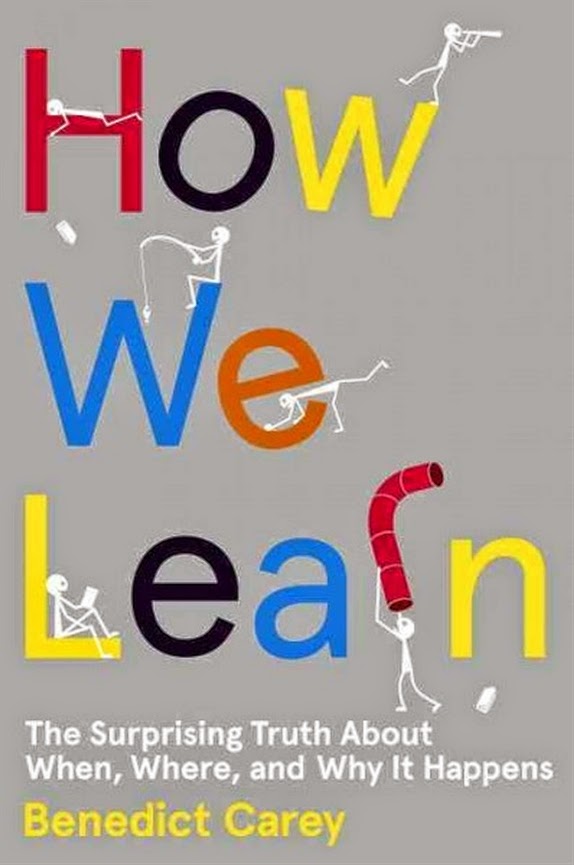
How We Learn: The Surprising Truth About When, Where, and Why It Happens

This book review originally appeared as part of the December 4 SAIS eNewsletter

If you were to put the major influences on how our brains developed in terms of shaping the way we learn onto a timeline, the first million-or-so years would consist of two main contributors: the search for food and the unending desire to survive. It is only in the last few thousand years that more ephemeral influences have begun to impact the way our brains adapt for learning. It is only in the last few hundred years that we as a species have put an edifice of education of our own creation around what we perceive to be the way we learn. 

The problem with this, says Benedict Carey, a New York Times science reporter and author of the book, How We Learn: The Surprising Truth About When, Where, and Why It Happens, is that this artifice of education often ignores all of the ways the brain really learns. What we’ve been taught about studying, practicing, and solving limits our ability to make learning last. Carey offers concrete strategies to capitalize on the first million years of brain development - that which made us hyper-aware of our surroundings, intent on finishing a project because of the need to accomplish a goal, or perceiving multiple factors at once to inform our next move. He accomplishes this by offering up a plethora of meta-research, experiments, personal anecdotes, and even puzzles to bring his points home. In fact, this is one of the more appealing aspects of the book - if you are looking for a relatively concise compilation of major research on the brain, memory, forgetting, and learning, How We Learn is an excellent resource. 


How We Learn, through Carey’s organization of the research, provides for the layperson an accessible and comprehensive account of the science behind learning. He divides his narrative into four main parts. In part one, he brings everyone up to speed on the biology of learning and the role that forgetting plays in how we learn. A little forgetting is good because it means you work the memory muscle when you need to recall something. Part two focuses on the retention of knowledge and builds on the memory theme by delving into the relationship of learning in different contexts to aid in retrieval of information, spaced learning or knowing when to start studying, and self examination as an active means of study. Part three discusses the best way to solve more complex problems and it is in this section of the book, where Carey’s best work lies. He does a masterful job of articulating the steps involved in the “Insight Experience” (p. 114), the power of percolation around a problem, and “interleaving” or mixed-up practice (p. 171). Finally, part four introduces the intriguing realm of perceptual learning modules as a means to “supplement experience” (p. 186) and dutifully outlines the importance of sleep in consolidating learning across modes, physical and/or mental. 


While Carey does an excellent job compiling interesting studies and organizing research on learning into categories that make sense, the outcomes of that research and how he proposes we use them practically are not really new news. For example, Carey’s insight about spacing study sessions over multiple days to make your mind work harder to recall information is, essentially, our teachers’ admonition to study a little at a time. His advice about taking a break and distracting yourself when stumped on a problem in order to capture that a-ha! moment when you return to work is essentially like taking a coffee break in the faculty room. His point about using multiple choice testing to force the brain to eliminate bad choices and “tune it” towards the right one is essentially every high school junior’s primary strategy going into the SAT. This is not to say these are not important points to keep in mind and understand as teachers, because they are. But for the most part, educators who are focused on best practices, research, and influential trends on education will not find any groundbreaking ideas in this book. However, it could be a great resource for new teachers, inquisitive and committed parents, and students who, in Carey’s words, may need to “broaden the margins” (p. xi) and give themselves a break every once in a while. 


Tuesday, August 12, 2014

5 Brain Facts That Influence How People Learn

http://www.dashe.com/blog/learning/five-brain-facts-learn/
This is a concise and helpful article on how the brain works when it comes to learning.

5 Brain Facts That Influence How People Learn

Wednesday, May 14, 2014

The Powerful Effect of Unstructured Play

I found this article on Twitter and it is a great reminder that unstructured play is essential for healthy development.

  • Let them struggle with the rules, 
  • let them argue "fairness,"
  • let them build forts and skin knees,
  • let them dam streams, and
  • let them relax. 

Monday, May 5, 2014

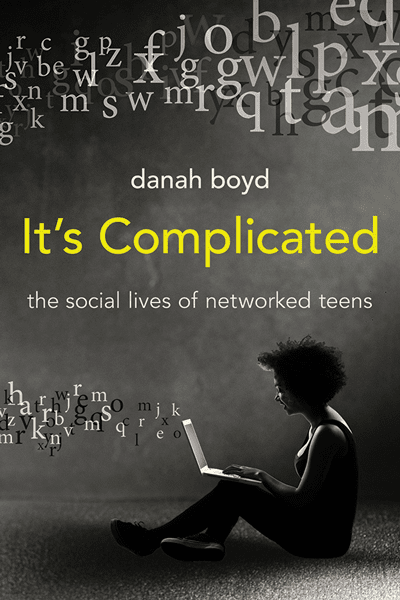
It's Complicated: A Book Review

This book review was originally posted on the SAIS website on 5/1/2014.

Teens & Social Media: It’s Complicated
A review of danah boyd’s new book, It’s Complicated: The Social Lives of Networked Teens
By David Skeen

Once upon a time in a land far, far away young people lived idyllic lives. Teenagers, as they were called, always - always - obeyed their parents. They would sit enthralled at the knees of their mothers and fathers, soaking up the hard-earned wisdom of these adults. Teens would tell their parents everything that was happening in their lives from the moment they woke up to the time they went to bed - at a reasonable hour, of course. Teens knew they needed their sleep and got plenty of it.  Teen years were happy, simple and easy.

One day an evil sorcerer named Internet arrived in the kingdom. Internet and his minions, MySpace, Facebook, Snapchat, Instagram, YouTube, and Twitter (collectively known as “Social Media”) enticed and lured teenagers to share their lives and ideas. As Internet’s insidious relationship with the youth of the kingdom took hold, teenagers grew moody, often shunning time with their parents so they could “hang out” with their friends. Parents knew very little about what was happening in their lives and were worried their children were not getting enough sleep. Most concerning of all, teens were pushing boundaries with their parents and searching for - gasp - their own identities.

In her new book, It’s Complicated: The Social Lives of Networked Teens, danah boyd (she does not capitalize her name) debunks the above fairy tale and brings us back to reality regarding “the anxieties that many American adults have about teens’ engagement with social media” (p. 5). Through ten years of study, 166 interviews with teens around the country, work at Berkeley, Harvard, and NYU (the twenty-one page bibliography is a testament to the depth of research), as well as her day job as Principal Researcher at Microsoft Research, danah boyd has written a book that is an essential read for educators and parents.

boyd’s premise begins with the idea that teen issues today are the same as they have always been.  Despite what she finds as a common desire by teens to hang out in person a combination of society’s fear and anxiety around our children, reduction in access to interpersonal settings such as the mall or the park and overscheduling force teens to flock to social media to do what teens do: socialize. These new “networked publics,” as boyd calls them, provide teenagers with what they’ve always wanted - opportunities to connect “with other people and have the freedom of mobility.” (p. 10)

The internet is neither good nor bad and social media is neither good nor bad. Both, however, are here to stay. Social media will not, as boyd outlines, usher in a utopia or destroy society but instead will act as a “reflection of our society and that mirror is going to be reflecting what we see. If we do not like what we see in that mirror the problem is not to fix the mirror, we have to fix society” (p. 212).  With this tenet in mind, boyd delves into seven topics related to teens and their networked world: identity, privacy, addiction, danger, bullying, inequality and literacy. Throughout each chapter, boyd maintains a narrative that is grounded in sociology rather than technology. Her findings are revealing. Some of the most intriguing include,

  • Teens today are “public by default and private through effort.” (p. 61)
  • Teens aren’t necessarily addicted to social media, but rather, as has long been the case, addicted to each other. (p. 80)
  • With the introduction of social media, like Elvis, comic books, and TV before it, parental anxieties are regenerated and the medium of the cultural shift becomes the target of a “moral panic.” (p. 105)
  • Teen friending patterns on social media consistently reinforced existing social divisions. (p. 165)
  • Digital Native vs. Digital Immigrant is a false precept. It abdicates our responsibility to teach our kids digital and media literacy. (p.180)

boyd’s voice of reason and research driven narrative provides a straightforward framework for conversations with teenagers. It’s Complicated should be required reading for all educators and parents in order to better understand this new(ish) platform of social media and its impact on our world. The good news is, as boyd herself states, while the names of Internet’s minions may change, the underlying story remains the same. Lessons learned from this book are enduring.

For most independent school educators, this work probably confirms a lot of what we have intuited about teen life and, therefore, offers a bridge for conversation with anxious parents. For parents, the book provides a calming voice. One who has an intimate knowledge of teenagers is saying quite clearly, “Our children’s world may be more complicated than we ever imagined but, by and large, they are going to be OK.”

Tuesday, April 29, 2014

Does Your Routine Enable Creativity?

Curated from Virgin Entrepreneur via Jack Preston, Content Manager
Check out this infographic that compares the daily routine of some of history's most creative minds.

Wednesday, April 23, 2014

Parentology by Dalton Conley

I came across a couple of book reviews of this book, Parentology by Dalton Conley, and thought it seemed like a thought-provoking read. I will be putting it on my summer reading list.

Tuesday, April 22, 2014

#Socialnomics 2014 by Erik Qualman


By now you've all seen the video that discusses how quickly the world has changed. Here is an updated version for your enjoyment.

Wednesday, March 26, 2014

Nanoscience is Really Cool


"...has been established as an academic collaboration between North Carolina Agricultural and Technical State University and The University of North Carolina at Greensboro. Both Universities are classified by the Carnegie Foundation as “research universities with high research activity.” JSNN builds on the strengths of the two universities in the basic sciences and in engineering to offer an innovative, cross-disciplinary graduate program that will train scientists in various emerging areas of nanoscience and nanoengineering."

We visited with the Nanoscience Department Chair, Dr. Daniel Herr (check out his TED talk) and were treated to an incredible tour of the facility. I've embedded the images we saw on the walls of the facility that came from the Helium Ion Microscope at JSNN and thought you would enjoy them.


Saturday, March 8, 2014

Must Read: It's Complicated by Danah Boyd

I've heard great things about this book and it comes from someone who spent a lot of time speaking withthose most affected - teens!

Check out an excerpt from an interview on Science Friday, as well as the Mind/Shift blog at this link:

Texts, Snapchats, Instagram: Translating Teens' Online Behavior

Wednesday, January 8, 2014

How Are Students Using Their Smartphones

I found another infographic I thought you might like on how students are using their smartphones. Some warnings on this particular study:

  1. It was administered by STUDYBLUE, a mobile and online study service, so there is some self-interest involved. 
  2. Despite #1, they did collect data from over a million users of their app and website. 
  3. There is still a lot of "other" things students are doing with their Smartphones during the study time, but an interesting conclusion that studying is happening more, overall with mobile technology. 

Wednesday, November 6, 2013

STEM Trip: 8th Grade to WFU Biology Lab

Nicole Schutt, one of our Middle School STEM teachers, sent along this report from the 8th grade's visit to Wake Forest yesterday:


8th grade Canterbury students took a trip to Wake Forest University to visit the Biology Lab facilities in Winston Hall.  They met with Dr. Ashley-Ross and her three Graduate students to learn about their current research and how it relates to our science studies of natural selection, adaptations, and evolution.  Students learned about the mangrove rivules fish, which uses a "tail flip" behavior to propel itself onto and across the land; the archer fish, which controls its spit to knock down prey above the water; and how the tarantula uses its legs to flip itself over when placed on its back.  This last project has joined with the Center for Design Innovation in Winston-Salem to apply what is learned to designing robots used in the field of science.  Students were entertained by Ben Perlman (pictured above) showing how the rivules controls its jumping behavior.  They also enjoyed a tour of the facilities and used some very impressive microscopes - one particular laser microscope was said to cost over $750,000!


Monday, October 28, 2013

Reframing the American Educational System


Milton Chen: Reframing the American Educational System from The Atlantic on FORA.tv

Mr. Chen wrote a recent article in the Summer 2013 edition of Independent School Magazine that sums up the WHY and the HOW behind the moves we are making here at Canterbury. This video echoes the same sentiments.

Here is the link to the article:

The Best Way to Predict the Future is to Invent It. Harnessing Technology in Schools. 

Thursday, October 24, 2013

ADHD as Difference in Cognition, Not Disorder

I found this TEDx talk this week and thought it went well with something I tweeted from the NY Times about the uptick in diagnosis in the last 30 years.


Monday, September 30, 2013

Monday, September 16, 2013

Resilience: How Skateboarding Can Teach Us How to Learn

I found this video on Twitter and thought it was a great way to think about how important resilience is to learning. Struggle and failure are GOOD things!


Monday, September 9, 2013

Mobile Devices for Learning

I found this video which outlines some of the projects that can come out of mobile learning. It is a few years old, but touches on some of the things we're trying to incorporate. Thanks to Amy Erin Borovoy at Edutopia for curating it. You can also find it on my What's Influencing Education Page.


Monday, August 5, 2013

Not Fair!

I found this video this morning on the blog 2¢ Worth and couldn't resist the comparison to middle school students. Plus it's really funny.

Fairness, or at least the perception of fairness, becomes a driving force in the lives of adolescents and nowhere does it come to the surface most than in middle school. One of the greatest tensions for middle school students is balancing this incredible urge to be an individual and treated uniquely, and demanding that everybody be treated the same. The black and white approach becomes grey over the four years they spend with us, and that in and of itself may be one of the greatest accomplishments a middle level educator can claim.


Monday, July 29, 2013

The Brain: Why Practice Makes Perfect

http://timeopinions.files.wordpress.com/
I read this article this weekend and thought it was a nice summary of the neurological benefits of "practice makes perfect" and why creative, authentic, multi-faceted approaches to teaching, learning, and producing make such a difference in our students' educational experiences.

Check out the blog post here.

Thursday, July 25, 2013

What's Influencing Education?

http://alphaschoolofenglish.com/
I was out with some friends the other night and one of them made the mistake of asking me what school is like these days. While I try not to geek out too much when this question is asked of me, this time my wife was not there to rein me in. I launched into all the incredible shifts in education that are happening - what Pat Bassett calls the Big Shift.

It got me thinking of ways I could curate the thinking that is influential on decisions being made at our school and schools like ours across the country. By no means do I offer this as the complete warehouse for ideas, but I've developed a page on this blog that spotlights the influences on education and the thinking that is driving this Big Shift. Check it out and let me know what you think.