Showing posts with label MS Vision: 21st Century Skills. Show all posts

Friday, December 5, 2014

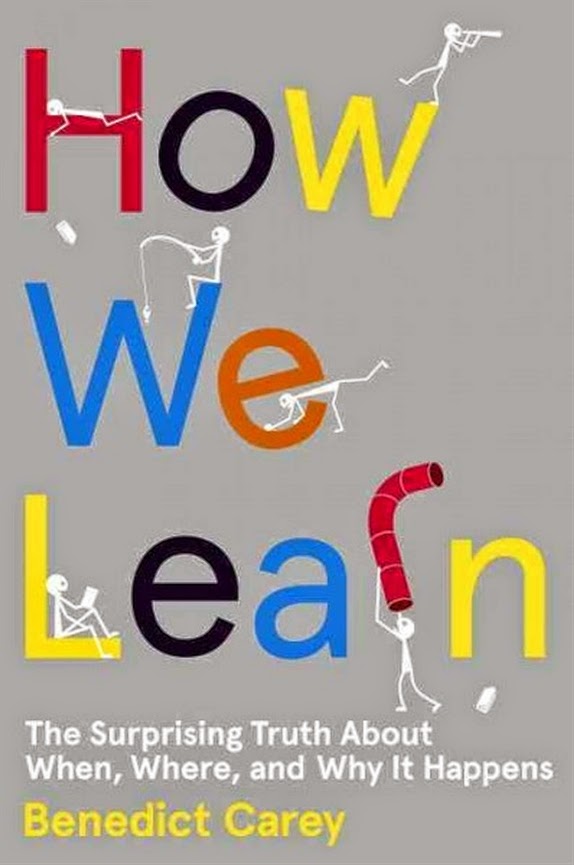
How We Learn: The Surprising Truth About When, Where, and Why It Happens

This book review originally appeared as part of the December 4 SAIS eNewsletter

If you were to put the major influences on how our brains developed in terms of shaping the way we learn onto a timeline, the first million-or-so years would consist of two main contributors: the search for food and the unending desire to survive. It is only in the last few thousand years that more ephemeral influences have begun to impact the way our brains adapt for learning. It is only in the last few hundred years that we as a species have put an edifice of education of our own creation around what we perceive to be the way we learn. 

The problem with this, says Benedict Carey, a New York Times science reporter and author of the book, How We Learn: The Surprising Truth About When, Where, and Why It Happens, is that this artifice of education often ignores all of the ways the brain really learns. What we’ve been taught about studying, practicing, and solving limits our ability to make learning last. Carey offers concrete strategies to capitalize on the first million years of brain development - that which made us hyper-aware of our surroundings, intent on finishing a project because of the need to accomplish a goal, or perceiving multiple factors at once to inform our next move. He accomplishes this by offering up a plethora of meta-research, experiments, personal anecdotes, and even puzzles to bring his points home. In fact, this is one of the more appealing aspects of the book - if you are looking for a relatively concise compilation of major research on the brain, memory, forgetting, and learning, How We Learn is an excellent resource. 


How We Learn, through Carey’s organization of the research, provides for the layperson an accessible and comprehensive account of the science behind learning. He divides his narrative into four main parts. In part one, he brings everyone up to speed on the biology of learning and the role that forgetting plays in how we learn. A little forgetting is good because it means you work the memory muscle when you need to recall something. Part two focuses on the retention of knowledge and builds on the memory theme by delving into the relationship of learning in different contexts to aid in retrieval of information, spaced learning or knowing when to start studying, and self examination as an active means of study. Part three discusses the best way to solve more complex problems and it is in this section of the book, where Carey’s best work lies. He does a masterful job of articulating the steps involved in the “Insight Experience” (p. 114), the power of percolation around a problem, and “interleaving” or mixed-up practice (p. 171). Finally, part four introduces the intriguing realm of perceptual learning modules as a means to “supplement experience” (p. 186) and dutifully outlines the importance of sleep in consolidating learning across modes, physical and/or mental. 


While Carey does an excellent job compiling interesting studies and organizing research on learning into categories that make sense, the outcomes of that research and how he proposes we use them practically are not really new news. For example, Carey’s insight about spacing study sessions over multiple days to make your mind work harder to recall information is, essentially, our teachers’ admonition to study a little at a time. His advice about taking a break and distracting yourself when stumped on a problem in order to capture that a-ha! moment when you return to work is essentially like taking a coffee break in the faculty room. His point about using multiple choice testing to force the brain to eliminate bad choices and “tune it” towards the right one is essentially every high school junior’s primary strategy going into the SAT. This is not to say these are not important points to keep in mind and understand as teachers, because they are. But for the most part, educators who are focused on best practices, research, and influential trends on education will not find any groundbreaking ideas in this book. However, it could be a great resource for new teachers, inquisitive and committed parents, and students who, in Carey’s words, may need to “broaden the margins” (p. xi) and give themselves a break every once in a while. 


Wednesday, September 3, 2014

Back to the Future: Experience 21st Century Teaching and Learning on Back to School Night

"Marty! Do you realize what this means?"


This classic line from Doc Brown in “Back to the Future” is perhaps overused, but in this case it is both appropriate and a little scary considering this fact: In “Back to the Future 2,” Marty travels into the future to the year 2015. Let that marinate a little bit...


We're not using hover-boards as regularly, nor do we fly our cars in express lanes, so our new Back to School Night (BTSN) format won't include an explanation on how the flux capacitor works, but it will provide a glimpse into how your children are learning in the 21st century. What follows is a description of the reasons behind this format change, what you can expect in terms of your experiences, and the schedule for the night.


School is Different Today

School is different today and for all the right reasons:
  1. Brain-based research has provided a deeper understanding of how people learn, thus providing insights into effective teaching practices.
  2. Developmental understandings of adolescents has deepened as well, meaning learning shouldn't just be about the WHAT anymore. The world in which our children will find themselves will be one defined by change, and the skill sets needed for this world are not content based necessarily, but relationship based.
  3. Part of that change is the role of technology and how to leverage its power. We see this most powerfully as a means to connect, while balancing its use in order to develop those relationship skills that will be so essential.


Why Change the Format of Back to School Night?

It is important to have some context around the decision to move to a new BTSN format. Over the course of the last few years, I've noticed trends that, taken together, instigated this change.
  1. The information being shared at BTSN was of a very basic nature and was being shared electronically with the students and parents anyway, thus creating a redundancy in communication.
  2. As middle school students move up in grades, there has a been a correlating drop in parent attendance at BTSN.
  3. There has been a lot of change in the middle school over the last four years, and while I have strived to fully communicate it in my Parent Preview letters and other communication outlets, such as this blog, the benefit to your children is best communicated through your own experience.


But I Love the Nuts and Bolts...

We believe it is important to show you how different school really is, and a perfect time to do so is BTSN. However, we understand that many of you rely on BTSN for the nuts and bolts of a class: How can I reach the teacher? What will my child be learning? How will they be assessed on that learning? How much homework can we expect at home? In response, each teacher has created a video which outlines that information for you. The videos will be embedded in their Haiku page, which you will learn more about from John Schoultz. Below is an example of the type of video you might see on a class page.


So What's So Different, Then?

Three things are different about this BTSN. First, starting in Berry Hall, we will launch our new Haiku platform, the main mode of communication moving forward. John Schoultz, our Instructional Technology Coordinator, will outline the basics of logging in and navigating through Haiku. After his presentation, you will receive an email with your log-in credentials and links to video tutorials, so you can access the platform right away.


Second, you will hear from Kathryn Wolfson, our new Guidance Counselor, about the Top 5 Guiding Principles in teaching adolescents. She will explain why these principles are so important to how we shape the middle school experience at Canterbury, and give you a sense of why we teach your children the way we do.


Third, you will move to Armfield Hall and attend two mini-lessons in your child's grade. Your assigned classes are at this LINK. Each lesson will last about 25 minutes and you'll have the opportunity to both engage in the material and ask questions about the process. Obviously, technology is a critical piece of the experience, and you will certainly see how it is integrated into a lesson, but we won't ask you to bring an iPad or laptop. Instead, we will show how your child would incorporate technology into the lesson.


Now What?

We want BTSN to be a launching pad for our partnership in your child's learning. We hope that through this new experience, you will have a better understanding of the expectations we have for the students and feel better prepared to support your child as he or she grows in middle school. At Parent-Teacher Conferences on Sept. 30, you can meet with your child's teachers one-on-one to further deepen that partnership. Our goal is to keep you fully informed about what is going in your child's experience at Canterbury, what best practice in middle level education is, why we believe it is important to do the things we do, and how we go about implementing those priorities at Canterbury.


We are excited to welcome you Back to the Future to experience 21st century teaching and learning for yourself.


The Night's Schedule

Here is the night's schedule.  

  • 6:00 - 6:30: Ketner Science and Technology Building Tours (optional) led by Burns Jones, Head of School
  • 6:30 - 7:00: Berry Hall
    • Welcome from Burns Jones, Head of School
    • New Middle School Teacher Introductions, Burns Jones, Head of School
    • Annual Fund Introduction, Matt and Rhonda Wakefield, Parents '18 & '20
    • Haiku Introduction, John Schoultz, Instructional Technology Coordinator
    • Guiding Principles of Teaching Adolescents, Kathryn Wolfson, Counselor
  • 7:05 - 7:30: Mini-lesson Session 1
  • 7:35 - 8:00: Mini-lesson Session 2

Tuesday, August 19, 2014

The Future of Talent is Potential: HBR Podcast

http://www.gradweb.co.uk/
In this fascinating podcast from HBR.org, Linda Hill and Claudio Fernandez-Araoz, discuss how businesses are shifting away from core competencies their workers need, and towards identifying potential for workers to adapt to ever-shifting problems and tools. Specifically, Fernandez-Araoz identifies five characteristics that great employees will have:

  1. A fierce, passionate commitment to unselfish goals
  2. Curiosity
  3. Insight - holistic thinkers
  4. Engagement - a willingness to engage others in the pursuit of a common goal
  5. Determination and resilience
The premise of Canterbury is to develop all of these characteristics in our students across a myriad of experiences, so they can be the future talent in high school, college, and the workplace. 

You can see it in our servant leadership and leadership program. 

You can see it in our STEM program with its foundational problem based approach. 

You can see it in our social studies program through events like the Millenial Development Goals project, where curiosity is stoked. 

You can see it in our Episcopal identity. 

You can see it in our students. 

Monday, August 18, 2014

The Future is Here: Apple, IBM Form Business Apps Partnership

http://miapplesinteractive.blogspot.com
If you didn't think our kids need to know how to navigate in a mobile tech world, this announcement from Apple and IBM, should wake you up. The two tech rivals are going into business together to take advantage of each other's strengths and complete the transformation of the way work gets done. As they said in their joint statement:

The business enterprise partnership, announced after Tuesday's market's close, aims to "redefine the way work will get done, address key industry mobility challenges and spark true mobile-led business change,'' the companies said in a joint statement.
This is no joke. Our kids need to learn how to use these tools to make their lives more efficient and be ready to make their future businesses more efficient.

Apple, IBM  Form Business Apps Partnership 

Welcome to 5th Grade!

Below you will find the presentation and speaking notes from our 5th grade parent orientation this afternoon.


Friday, August 15, 2014

Creating Legacy Work: Innovation in Schools via Alan November


Paul Kostak, our 5th and 6th Grade Science teacher, and John Schoultz, our EdTech Coordinator, went to the ISTE Conference this summer and heard Alan November speak about the future of education. They put me onto this TED talk, which outlines Alan's story and how the "future" of education has always been here, it just needs to adapt to the tools of the era. The principles of best practice teaching and learning don't change. Enjoy.

Monday, August 11, 2014

Should I Be Good or Successful?

http://izquotes.com/
I heard this segment on NPR last month and felt it was something we should really be paying a lot of attention. The driving question: Do kids think their parents want them to be good or successful?

The premise of the story is that many of us as parents say we just want our children to grow up to be good people, but a Harvard study says otherwise. While we say we want them to be good people, we often send unspoken messages which rewards success. Here's a snippet:

If their daughter, Mila, 15, had to say whether her parents cared more about her being good to others or being successful, she says it'd be close, but she'd have to say "good," she hedges. 
Her brother, James, 13, however, doesn't hesitate. 
"Successful," he says. 
How does he know? Because achievement in school is what his parents nag him about, and reward him for, the most. For example, they let him quit volunteering at the soup kitchen when he didn't like it, but he gets no such pass on schoolwork. Similarly, Mila says, her parents got really happy and took her out to a nice restaurant for dinner to reward her for getting a B instead of a C. 
"It's one of those things people say, like, I really want you to be a good person, like that's my main thing," she says. "But deep inside, it's like, but I really want you to be successful."
 As a school we believe that the messages we should send to our students is that serving others through your gifts is success. This is the premise on which our Servant Leadership program is based. I highly recommend this article and let me know what you think!

For Most Kids, Nice Finishes Last


Thursday, August 7, 2014

Let's Get Your Head Right: A Parent Primer Series

http://www.keepcalm-o-matic.co.uk/
Let's face it: school is about to start. As absurd as it may seem, students will be roaming the halls this month and I'm not sure any of us are ready for it! Summer is over! I have a friend whose favorite saying in times like these is to, "get your head right!" Well, it's time we kept calm and did just that.

In an effort to work our way back into school-mode and provide a context for WHY we do WHAT we do and HOW we do it, I thought a series of blog posts over the next few weeks might be helpful. I don't want to overload you, so this primer series, as I'm calling it will feature single articles, videos, or infographics with some editorial comments introducing them.

I've organized the posts to hopefully offer insights into the big questions surrounding middle level education. These questions fall into four broad categories including,

  1. Child Development
    • How are children growing up these days? 
    • What is their world like and how can we help? 
    • What should we be keeping in mind as we enter a new school year about how our kids are growing and interacting? 
  2. Innovation
    • What is happening in government/business/demographics that influence the world into which our children will enter?
    • How can we capitalize on innovations elsewhere and use them as learning tools in school? 
    • Are there principles from other industries that translate well into teaching and learning? 
  3. Curriculum and Program 
    • What are the best practices out there for middle level education? 
    • What is influencing our curriculum and program? 
    • How is Canterbury proactively positioning itself to develop students who will be leaders of the future? 
  4. Technology
    • How is Technology being used in education? 
    • What are the issues students, teachers, and parents face related to technology integration? 
    • How can we support students, teachers, and parents with technology?  
This series mirrors my summer on Twitter, which I can't promote enough as an incredible resource for anybody looking to delve deeply into the topics of the day. Almost all of these articles, video, or links were curated by people or institutions I follow on Twitter. If you follow me on Twitter @MSDirectorSkeen, you've likely seen me retweet many of these resources already. I will continue to post often on Twitter and for those pieces that deserve more in depth analysis, they will be coming to the blog. 

I hope you enjoy the rest of your summer and we'll see you soon!


Wednesday, June 25, 2014

6th Grade Teacher, Karen Niegelsky, Wins Award

Karen Niegelsky, our 6th grade Humanities and Composition teacher has won the Walden Media's contest, Teachers are Givers. Her unit on community and dystopia as seen through The Giver won the award. You can check out her lesson and accolades at the link below:

http://www.walden.com/blog/teachers-are-givers-week-3-winner-karen-niegelsky/

Thursday, March 13, 2014

Addressing the Whole Child via Technology (Maslow's Hierarchy)

I found this article (and infographic) via Dr. Jackie Gerstein about how Maslow's Hierarchy of needs can be addressed with technology and thought it was an interesting take on the whole child - something that is fundamental to us at Canterbury.

Addressing Maslow's Hierarchy of Needs with Technology

Monday, February 10, 2014

In My Neighbors' Shoes

http://jelia.wordpress.com/
On February 19 we will begin the In My Neighbors’ Shoes experiences which involves grade level service learning trips that focus on building understanding and empathy for our neighbors in Greensboro. 

The 5th grade will have the opportunity to engage with and learn from students at Haynes-Inman Education Center, a school that serves students with severe to profound cognitive and/or physical disabilities. 

The 6th grade will be focusing on interfaith understanding, as part of their Theology studies of the Abrahamic faiths. They will be visiting the Islamic Center of Greensboro and the Beth David Synagogue. 

The 7th grade will focus on their work with the Millennium Development Goals in Social Studies and learn about water quality and sanitation at the Townsend Water Treatment Plant and the immigrant experience at Faith Action International House. 

The 8th grade will be going on a series of small group trips that emulate the experience of the working poor in Greensboro.  These groups will be navigating the public transportation system, shopping for groceries, navigating the court system, and a will be taking a basic tour of the correction center.

We have created a website that you can follow for up-to-the-minute updates and resources as we prepare, engage, and reflect on the experiences of our neighbors. Check it out at


You can also follow the experience on Twitter @CburyServLearn. If you have any questions or you want to be a part of it all, please do not hesitate to contact me at 336-288-2007 x 131 or skeend@canterburygso.org .

Monday, February 3, 2014

6th Grade First Friends Experience


Anne-Barton Carter's 6th Grade Servant Leadership Class visited the food pantry at First Friends Meeting the other day and had a great time. They received some great feedback. Check out the visit and the feedback below:

From Sheila to all at First Friends involved with the food pantry:

Just wanted to share with you about how amazing yesterday was in the food pantry!
Here are some of the reasons:

A class of 14 students from Canterbury, their teacher Anne Barton and two adults came to learn about the pantry and then they set up several activities for our pantry friends to partake in while they waited. It was AMAZING! There were valentines, coloring, pictionary, cookies being decorated, extra helpers and even some video interviews going on! Folks seem to love having the kids there and the kids were loving on our friends. CAROL WHITLEY and FREDRICK JOHNSON came in to share with the class as well and they were wonerful speakers.

From one of the couples that volunteers each month:

The Canterbury students who worked at the food pantry were some of the most amazing young people we've encountered. They were so engaging, engaged, warm, compassionate, positive (I could go on!) imaginable. Thank you for sharing them with First Friends. The food pantry clients loved being with them and the interacting with them. Fellowship Hall felt like a warm reunion of friends having lots of fun!

We went away truly optimistic about the future!


Friday, January 17, 2014

Monday, January 13, 2014

SPENT: Incredible Simulation Game for Empathy Building


Anne-Barton Carter shared this website with our 8th graders to begin to build a sense of empathy for the working poor. It is an incredible interactive website that tugs at the heartstrings and forces you to be in another's shoes. Check it out:

http://playspent.org/

Wednesday, January 8, 2014

How Are Students Using Their Smartphones

I found another infographic I thought you might like on how students are using their smartphones. Some warnings on this particular study:

  1. It was administered by STUDYBLUE, a mobile and online study service, so there is some self-interest involved. 
  2. Despite #1, they did collect data from over a million users of their app and website. 
  3. There is still a lot of "other" things students are doing with their Smartphones during the study time, but an interesting conclusion that studying is happening more, overall with mobile technology. 

Monday, November 18, 2013

Minecraft Utopia Projects

In our 6th Grade Humanities classes, Karen Niegelsky had students develop their own utopias. A few groups used Minecraft to create theirs. What transpired was pretty incredible. Check it out:

Wednesday, November 13, 2013

BYOD: Achieving Learning Outcomes Across Operating Systems

Below is an infographic that shows how you can achieve learning outcomes regardless of the operating system. This is just a taste of the possibilities. From edudemic.com


Monday, November 11, 2013

NCAIS Innovate: BYOD @ C'Bury

On Friday, November 1, John Schoultz and I presented at the NCAIS Innovate Conference. Many thanks to Laura Blackburn and the NCAIS team for setting up a great conference. Below is our presentation:


Thursday, November 7, 2013

8th Grade Internships

This year we instituted an 8th grade internship program. 8th graders are working with staff and faculty on meaningful internships throughout the school that help to develop a deeper understanding of the school, provide an opportunity to develop relationships outside of their peer group, and engrain a sense of commitment and dedication to a larger purpose. Check out Caroline Fitzgerald at work with a Kindergartner on Math:


Wednesday, November 6, 2013

STEM Trip: 8th Grade to WFU Biology Lab

Nicole Schutt, one of our Middle School STEM teachers, sent along this report from the 8th grade's visit to Wake Forest yesterday:


8th grade Canterbury students took a trip to Wake Forest University to visit the Biology Lab facilities in Winston Hall.  They met with Dr. Ashley-Ross and her three Graduate students to learn about their current research and how it relates to our science studies of natural selection, adaptations, and evolution.  Students learned about the mangrove rivules fish, which uses a "tail flip" behavior to propel itself onto and across the land; the archer fish, which controls its spit to knock down prey above the water; and how the tarantula uses its legs to flip itself over when placed on its back.  This last project has joined with the Center for Design Innovation in Winston-Salem to apply what is learned to designing robots used in the field of science.  Students were entertained by Ben Perlman (pictured above) showing how the rivules controls its jumping behavior.  They also enjoyed a tour of the facilities and used some very impressive microscopes - one particular laser microscope was said to cost over $750,000!